Exploratory personal project. Not an official assessment and not a seafood recommendation.
Pacific herring
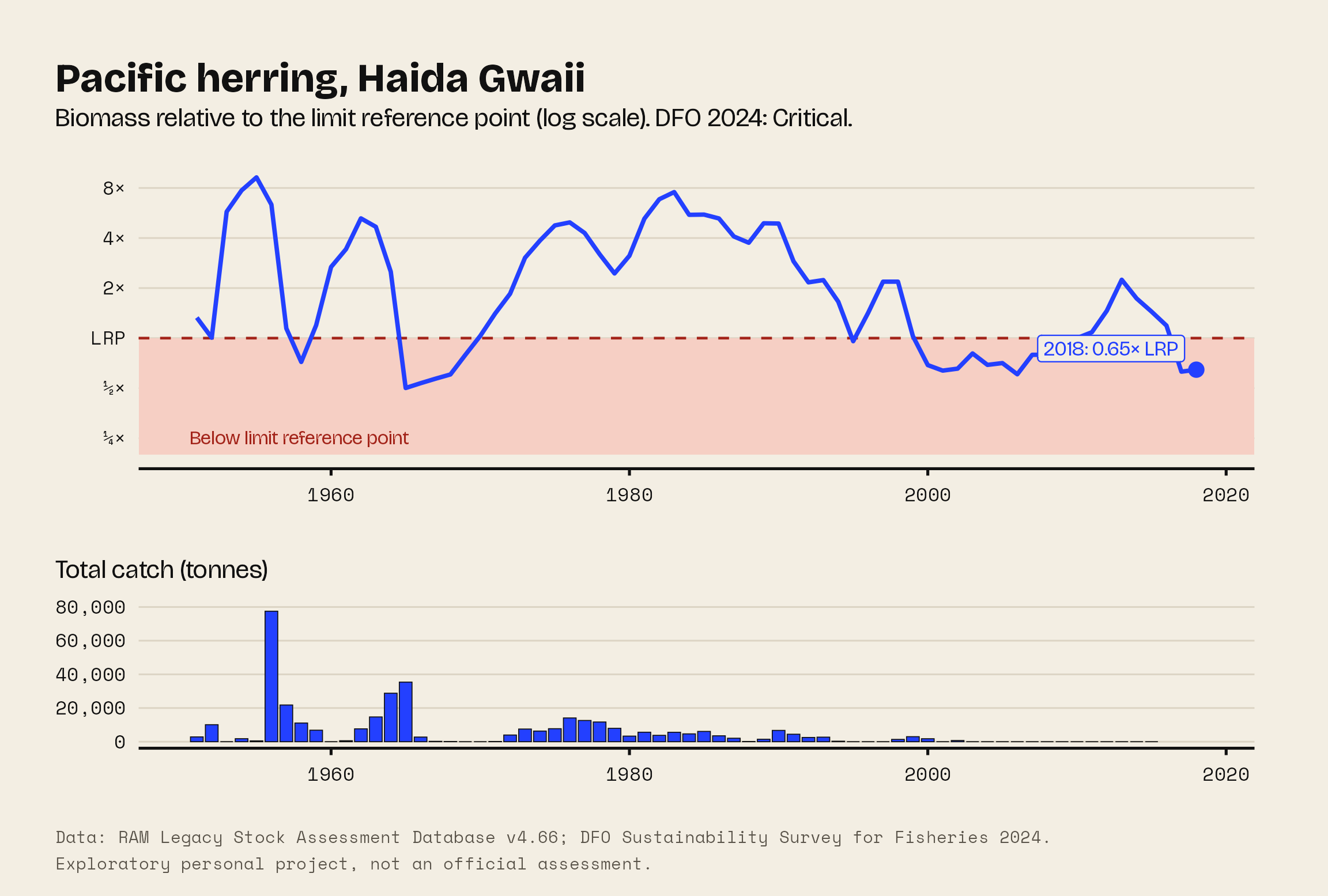
Pacific herring, Haida Gwaii
DFO 2024: Critical
Data tier C
0.65× LRP
Biomass relative to the limit reference point, 2018

- Evidence
- Biomass and catch trends, no MSY ratios
- Managed by
- Fisheries and Oceans Canada (DFO)
- Status method
- Scientific Peer Review Process
- RAM assessment period
- 1949-2018
- Biomass estimates
- 1951 to 2018
Fun fact: Herring spawn in shallow coastal water, laying sticky eggs on kelp and eelgrass.
Management context
Text in quotation marks is copied exactly as published in DFO’s 2024 Sustainability Survey for Fisheries, including any typos.
- Limit reference point, as described by DFO: “0.3SBo (unfished spawning biomass) or 6,347 tonnes* (median value, estimates are updated annually) *value reported from the 2023 stock assessment, implemented for 2023/24 fishery”
- Upper stock reference, as described by DFO: “Provisional USRs are considered spawning biomass objectives in the MSE process and are not considered equivalent to the upper control point of the harvest control rule. Haida Gwaii herring reference points are developed through the HG rebuilding plan process.”
- Limit used for this project’s indicator: 0.3 x unfished spawning biomass (SSB0 from the 2018 assessment in RAM)
- Management plan, as reported by DFO: “2023/24 Pacific Herring IFMP - November 7, 2023 - November 6, 2024”
- Managed by: Fisheries and Oceans Canada (DFO)
Science documents cited by DFO in the 2024 survey:
Data gaps and caveats
- Time series ends in 2018; the DFO zone is from the 2024 survey.
- No fishing-pressure ratio relative to MSY, so no Kobe plot.
- Limit reference point taken or derived from RAM Legacy; DFO’s current value may differ.
← Back to all stock cards