
Independent portfolio project · Python · R · QGIS · open data
How much of Ontario’s caribou range is staked for mining?
Active mining claims cover 10.6% of Ontario’s woodland caribou ranges, as of 13 November 2026. This project downloads the province’s claims data automatically, measures the overlap with each of the 14 ranges, and tracks how claim staking has changed since Ontario moved registration online in 2018.
Explore the ranges Methods and data Code on GitHub
Background: one stripe per year since 2018, brighter where a larger share of newly staked land fell inside caribou range. The latest year runs to 13 November 2026.
10.6%
of caribou range under active claim
50,900
km² claimed, nearly the size of Nova Scotia
31%
of the Sydney range, the most heavily claimed
60%
of land staked in 2025 fell inside caribou range
A mining claim is not a mine, and overlap is not impact. A claim gives the right to explore for minerals, and most claims never lead to a mine. These figures show where exploration rights exist in caribou range, not where habitat has been disturbed.
Explore the ranges
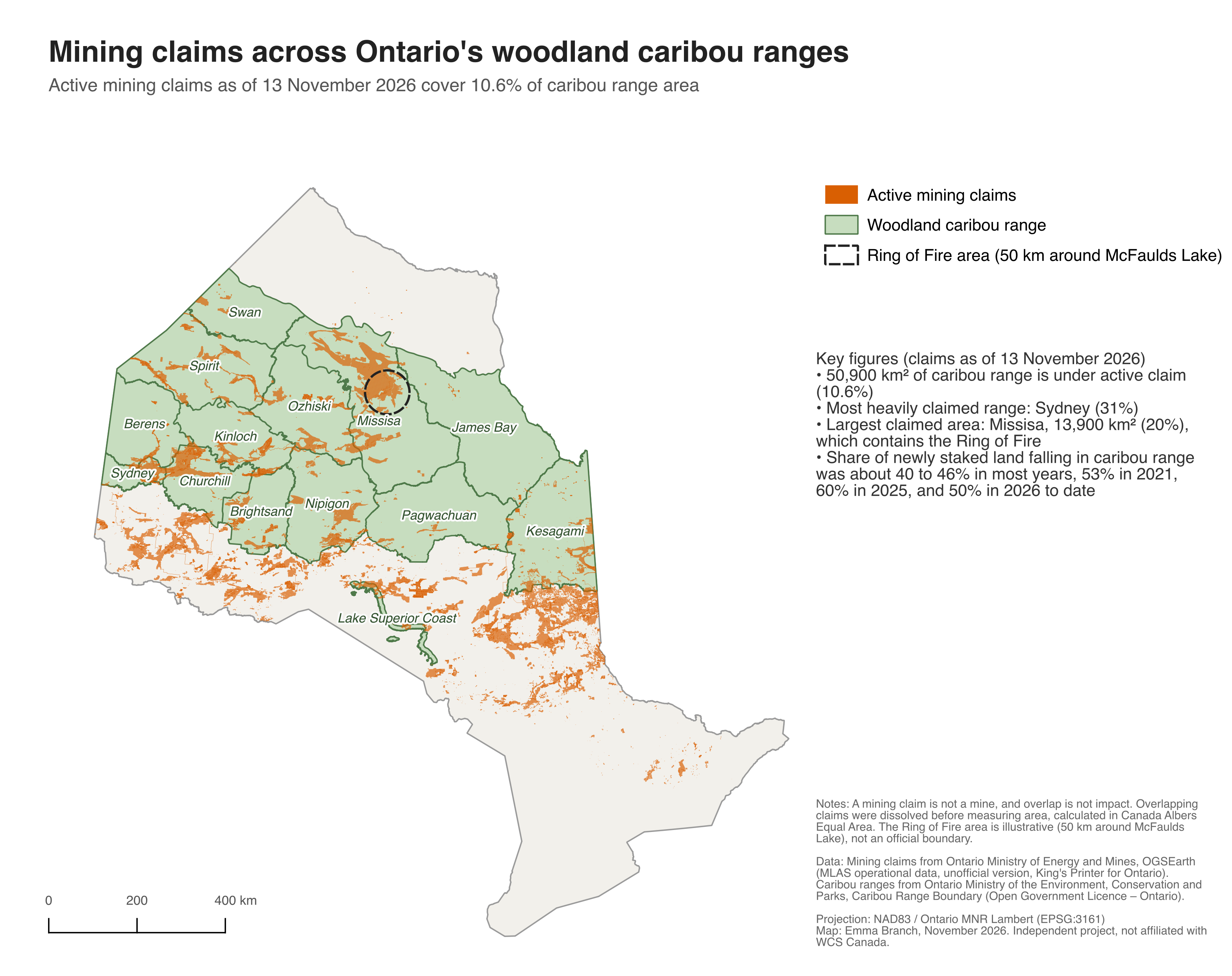
Click a range to see how much of it is under active claim. The dashed circle marks an illustrative Ring of Fire area (50 km around McFaulds Lake), not an official boundary.
The map
Every active claim, drawn without outlines so 411,000 claims read as a single footprint. Claims cluster around the Ring of Fire, along the southern edge of the ranges, and in the northeast.
Which ranges are most claimed?
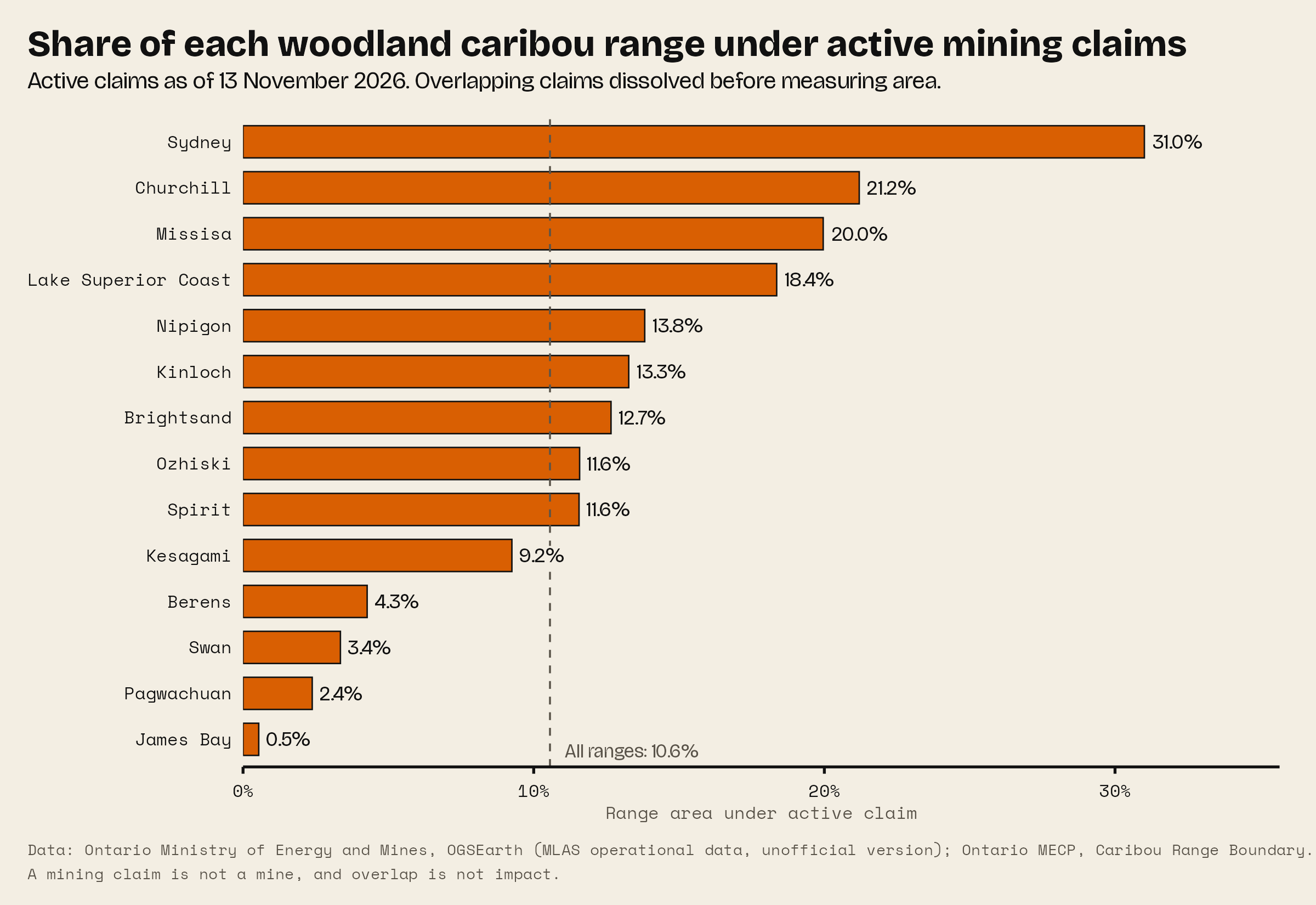
The Sydney range has the highest share under claim. Missisa, which contains the Ring of Fire, has the largest claimed area of any range.
How has staking changed?
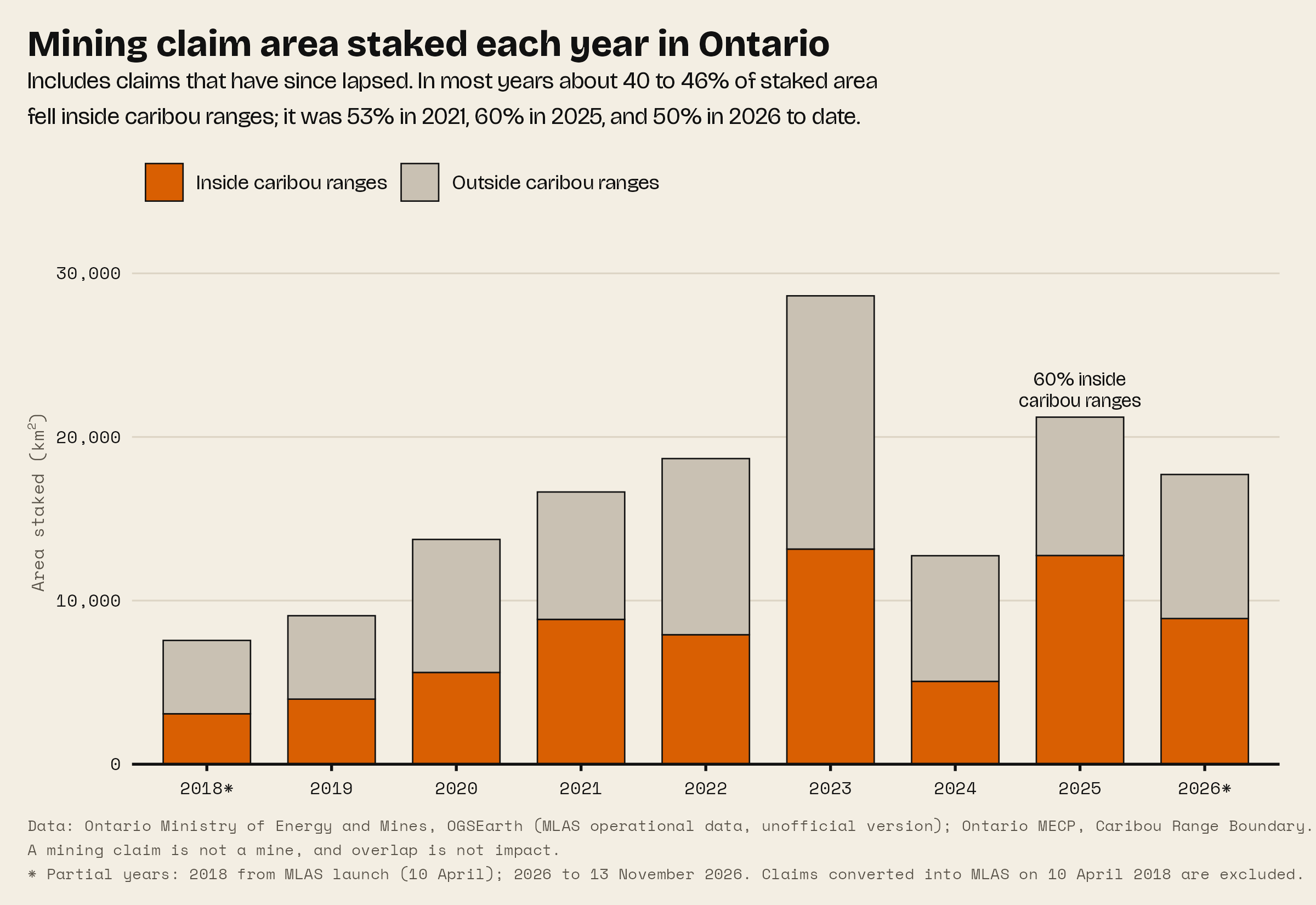
Counting claims that have since lapsed as well as active ones, area staked per year peaked in 2023. In most years about 40 to 46% of staked land fell inside caribou range, rising to 53% in 2021 and 60% in 2025.
About this project
An independent portfolio project inspired by WCS Canada’s Ontario Mineral Tracker. It is not affiliated with, endorsed by, or produced for WCS Canada. See Methods and data for sources, licences, processing decisions, and limitations, or the code on GitHub.