Map
Where and when whales are seen, and the boat traffic they share the sea with.
A year in the Salish Sea
Each dot below is a whale sighting, pooled across 2018 to 2025 and sorted by month. Press play, or drag the slider, and switch species on and off with the buttons next to the map.
Whales in the traffic
Switch on Ferry routes and Shipping lanes on the map at the top of this page to see the boat traffic whales share the sea with.
Ferry routes and shipping lanes, plus 2 km either side, cover about a third of the Salish Sea. About half of all whale sightings fall in that zone. So whales turn up near busy routes a little more than the area alone predicts, but not dramatically.
- Humpbacks are seen near shipping lanes 1.7 times as often as chance would suggest. The lanes run through Juan de Fuca Strait, the humpbacks’ busiest feeding area, which is why ship strikes are a concern.
- Orcas are seen near ferry routes 1.7 times as often. Some of that is where orcas travel, and some is that a ferry is a floating viewing deck full of people with phones.
- Grey whales mostly stay out of the shipping lanes (0.6 times), feeding in shallow bays instead.
As with everything else here, these are sightings, so they show where whales and watchers overlap, not where whales are.
When each species visits
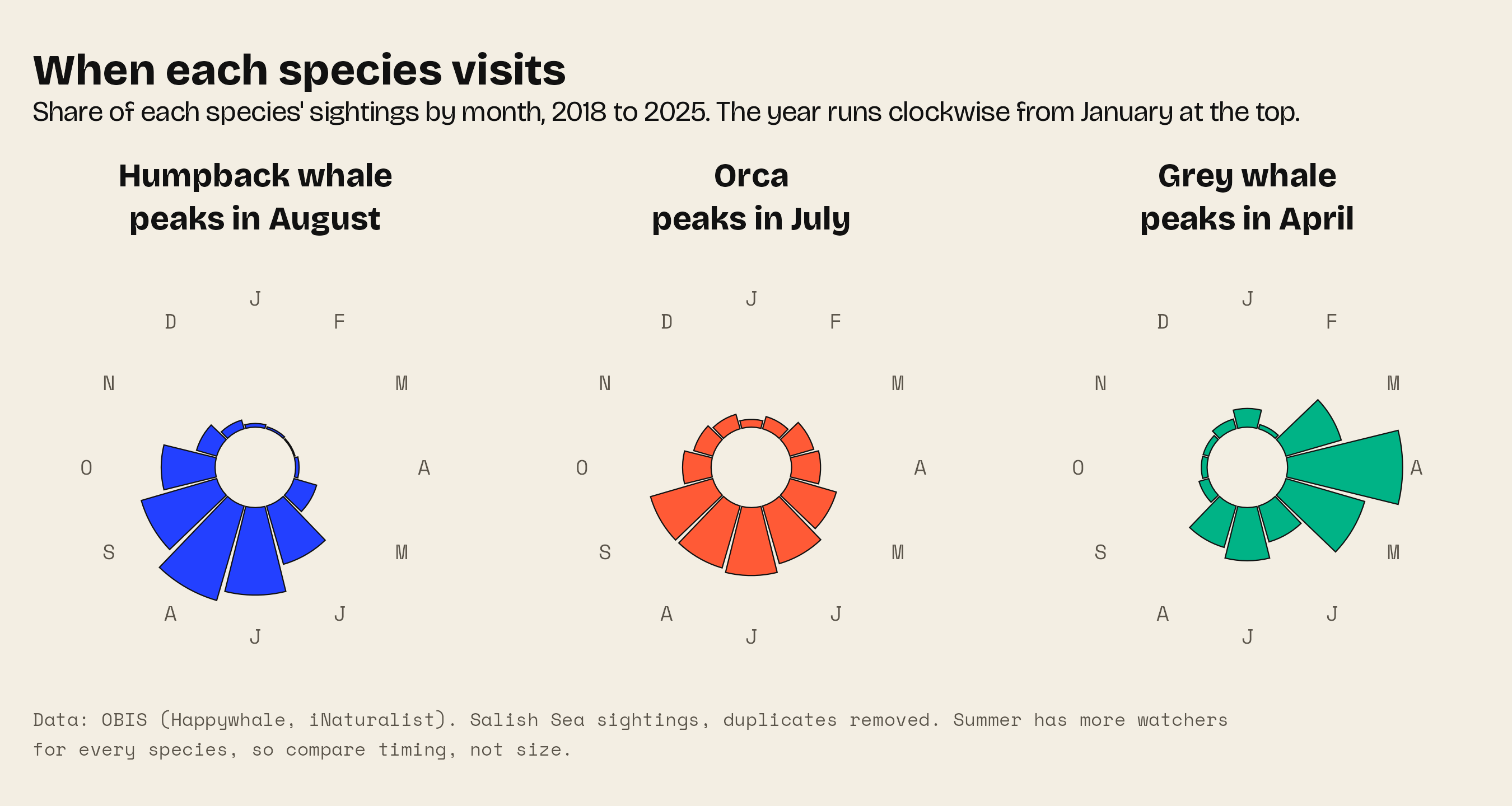
The three species keep very different calendars.
- Grey whales are a spring story. 57% of their sightings fall between March and May, and most are in one corner of northern Puget Sound. That fits the “Sounders”, a small group of grey whales that leave their northward migration to feed on ghost shrimp for two to three months each spring, around Whidbey and Camano Islands.
- Humpbacks arrive in summer and leave in autumn. 86% of their sightings fall between June and October, mostly in Juan de Fuca Strait and the central Strait of Georgia.
- Orcas are the most year-round of the three. They peak from May to September but turn up in every month.